
MyHeritage adds and Ancestry clarifies AI limits
Yep, it’s terms-of-service season at the genealogy websites, and this year — not surprisingly — there’s a clear showdown going on between major content providers on one side and the agents of artificial intelligence on the other.
And yep it’s absolutely going to impact our individual research and research methodologies as well — even if we can’t quite be sure just how just yet.
Sigh…
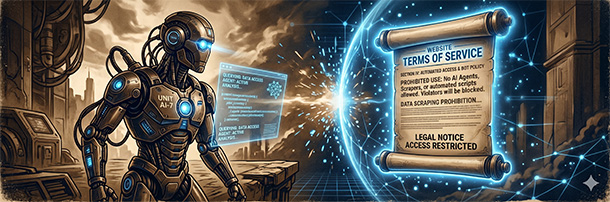
So… to put this into context, remember that terms of service (TOS) — or terms and conditions or terms of use or whatever this happens to be called at a particular website — are the limits somebody who owns something you want to see or copy or use puts on whether or not he’ll let you see or copy or use it. These are limits that are different from copyright protection, since the law says what is and isn’t copyrighted and you can own a thing without owning the copyright. So this isn’t copyright law; it’s contract law — you and whoever owns the thing you want to see or copy or use reach a deal. Yes, it’s a take-it-or-leave type of deal, but the law says — sigh — that’s perfectly okay. You either accept the terms, or you don’t use that website.1
First up in this year’s AI-limiting terms for genealogy was MyHeritage, which updated its terms and conditions last month, adding this language:
Restrictions on AI Harvesting and Interaction: The use of AI agents, bots, automated systems, or any other artificial intelligence technology (“AI Tools”) to access, scrape, crawl, harvest, or collect data from the Website or Service (including but not limited to family trees, historical records, photographs, and DNA results) is strictly prohibited. Furthermore, you may not use AI Tools to interact with the Website’s features, automated workflows, or messaging systems. You are expressly forbidden from using any content, data, or information from the Website or Service to train, develop, improve, or operate any artificial intelligence model, machine learning system, large language model (LLM), or similar technology.2
Prohibition on AI Proxies and Gateway Accounts: You must not facilitate access to your MyHeritage account by any AI Tool or third-party automated interface. This includes, without limitation, arranging for an AI Tool to access the Service to provide a derivative service, search function, or data summary for yourself, other users, or any other third party. Using your account as a “gateway” to provide AI-based insights to non-subscribers is a material breach of these Terms, intended to protect the proprietary nature of our database and the subscription-based access model of the Service. Any use of the Service that bypasses our subscription requirements or facilitates unauthorized access to our database via AI-mediated tools is a material breach of these Terms and will result in the immediate termination of your account and potential legal action.3
Then it added to its general license language (“You are hereby granted a license to use the Service and the Website solely for personal use”) some limits that had not been there before. That section now reads: “You are hereby granted a license to use the Service and the Website solely for personal, non-commercial, and human use…”4
It’s clear these terms bar users from handing over their log-in credentials to an AI agent. It isn’t clear, at least not yet, what limits MyHeritage might try to enforce if a user personally gathers information from the website content and uploads it to an AI platform — nor is it entirely clear how MyHeritage intends to limit use of its web content by professional genealogists working for clients.
Ancestry joined in with a terms-and-conditions update today, updating its limits on AI-based agents. Previously, it barred “use of any artificial intelligence, bots, crawlers, spiders, data-miners, scrapers or other tools that facilitate rapid and bulk data collection.” 5 That section now provides that users may not “access, acquire, copy, or monitor any portion of the Services by any manual, automated, or programmatic method that exceeds the intended standard human use of the Services; or to use any data or content from the Services to train, develop, or fine-tune any machine learning model, algorithm, or artificial intelligence system.”6
Once again, how much use will be considered manual acquisition of content remains to be seen.
Two other notable changes were made in the Ancestry TOS, not AI-related but worth paying attention to. First, after last year’s brouhaha about whether a ban on using Ancestry for use in any judicial proceeding — which had genealogists who work in probate cases concerns, the terms were amended to limit the ban to using Ancestry’s DNA service “in any criminal judicial proceeding.”7 At the same time, Ancestry’s Privacy Statement was amended to bar not just law enforcement use of the service to investigate crimes or to identify human remains but use by “anyone working on their behalf.”8
And, second, Ancestry has expressly provided for a method for users to designate someone to gain control of their account as a future beneficiary. The provision reads:
Legacy Accounts and Named Beneficiaries. To help preserve your family history, you can designate a “Legacy Contact” in your Account Settings to receive access to your account if you can’t use it anymore. If a transfer request is made, we will verify the Legacy Contact’s identity and require proof of the qualifying event (such as a death certificate) before granting access. Upon verification, we will share your account access and Personal Information with your designated contact. They will then assume ownership of the account.9
To access that feature, users can go to their profile, choose Account Settings from the dropdown menu, then scroll down to Legacy Contact and enter a name and email.
There are of course a whole host of other relatively minor language changes in the terms — mostly to accommodate changes in the laws in countries around the world. But these spring 2026 changes suggest that the big battle in the future will be between content providers like the genealogy websites and content acquisition systems driven by AI that we as individuals want to use to assist with and streamline our research methodologies.
Fasten your seatbelts.
It’s gonna be a bumpy ride.
Image generated by Google Gemini, 12 May 2026, in response to this user’s prompt.
Cite/link to this post: Judy G. Russell, “AI meets TOS,” The Legal Genealogist (https://www.legalgenealogist.com/blog/ : posted 12 May 2026).
SOURCES
- See generally Judy G. Russell, “A terms of use intro,” The Legal Genealogist, posted 29 Apr 2015 (https://www.legalgenealogist.com/blog : accessed 11 May 2026). ↩
- “Your use of the Website or Service,” MyHeritage – Terms and Conditions, updated 16 April 2026, MyHeritage (https://www.myheritage.com/ : accessed 12 May 2026). ↩
- Ibid. ↩
- Ibid., “Limited Use License,” emphasis added. ↩
- “1.3 Use of the Services,” 2025 version, Ancestry Terms and Conditions, effective 18 Aug 2025, via Wayback Machine, Internet Archive, (https://web.archive.org/ : accessed 12 May 2026). ↩
- “1.3 Use of the Services,” Ancestry Terms and Conditions, updated 12 May 2026, Ancestry (https://www.ancestry.com/ : accessed 12 May 2026). ↩
- Ibid., “1.4.2 Your Use of DNA Services,” emphasis added. ↩
- “7. What Information Do We Share, When Do We Share It and Who Are the Recipients?,” Ancestry Privacy Statement, updated 12 May 2026, Ancestry (https://www.ancestry.com/ : accessed 12 May 2026). ↩
- Ibid. ↩

