
Great DNA utility website
NOTE: This blog’s recommendation of GEDmatch has been withdrawn due to privacy issues. See “Withdrawing a recommendation,” The Legal Genealogist (https://www.legalgenealogist.com/blog : posted 15 May 2019).
[Note: There’s an Updated look at GedMatch published in 2017.]
It occasionally surprises The Legal Genealogist to realize that not everyone is ready, willing and able to test with every DNA company on the planet, or at least in the United States. Just because doing a full round of tests with Family Tree DNA, 23andMe, AncestryDNA and others will set you back somewhere in the neighborhood of a grand or more is no reason not to let loose your inner DNA geek, is it?
Oh. Yeah. Right.
There is that little problem of the mortgage and the kids’ school clothes and that doctor bill and…
Sigh… Don’t you just hate it when real life interferes with what you want to do?
 So to fill in some of the gaps, at least for autosomal DNA tests, let me introduce you to a wonderful website: GEDmatch.com, with tools for genetic genealogy research that carry a whopping big price tag of exactly zero. That’s not a typo. The site is free, though donations are gratefully accepted and anybody who uses the site really should kick in — it isn’t cheap to provide the kind of computing power Gedmatch provides.
The brainchild of Curtis Rogers and John Olson (a distant DNA cousin of mine), Gedmatch offers a range of utilities that make it a little easier to extract every bit of potentially useful information out of your autosomal test results. Autosomal DNA testing, remember, is the kind that works across gender lines so you don’t have to find a direct male line from father to son to son (YDNA or Y-DNA1) or a direct female line from mother to daughter to daughter (mitochondrial DNA or mtDNA2). It particularly helps you identify cousins with whom you can share research.3
To use the site to full advantage, you need to download your raw autosomal DNA test results and match lists from your testing company and then upload them to Gedmatch. Both Family Tree DNA and 23andMe make raw data available — AncestryDNA does not — and directions for downloading are on the Gedmatch site. Gedmatch works with the raw results from deCODEme as well. And you can upload a GEDCOM with your family tree to see if you can identify common lines, using technology to help with traditional paper-trail genealogy too.
Although you do have to provide your email address and the exact name you used with your testing company, you don’t have to use your name publicly. You can be John’s Mom, or CountryCuzzin, if you prefer. You don’t have to make any of your information public if you’d rather not, although the utility of the website is limited if you don’t.
Once you’ve uploaded all the files — and there’s more than one to upload — you’re ready to start playing with the utilities.
First, you can compare your results with the results of all other Gedmatch users who’ve made their results public — no matter what company they’ve tested with:

The results can be sorted by the total amount of DNA you have in common with others, measured in units called centimorgans or cM,4 by the longest segment you share, by the number of generations you’re likely distant from your matches and more. Email addresses of your matches may be listed, but can’t be copied-and-pasted to protect them from harvesting by spammers.
You can choose to see information about selected matches in a chromosome browser. Here’s what my results look like against my two uncles and my aunt on Chromosome 1:

And there are several matrix displays available that will display your selected matches not only as they match you but as they match each other, including a very useful option for displaying estimated distance to the most recent common ancestor.
There’s a genetic distance calculator, a relationship calculator, the ability to triangulate on match results to see how you and your match relate to others, a tool for checking to see if your parents are related to each other, and more.
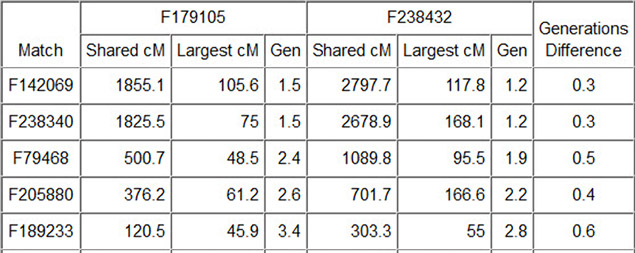
One of my favorite tools is a quick and easy tool labeled “People who match one person, but not the other …and people who match the same 2 people.” I use it to see others that I have in common with a match, and it quickly produces a chart showing information as to how each of us compares to each common match. The chart does have email addresses, deleted here in this example showing matches I share with an uncle.
There’s more than enough here to satisfy your inner DNA geek. You can phase data — if you and one or both of your parents have tested, this utility will help identify what portions of your DNA came from which parent.
And there are six different options for displaying admixture (ethnicity or deep ancestry) data — and each of the six has options galore. Here’s my admixture under just one of those options:

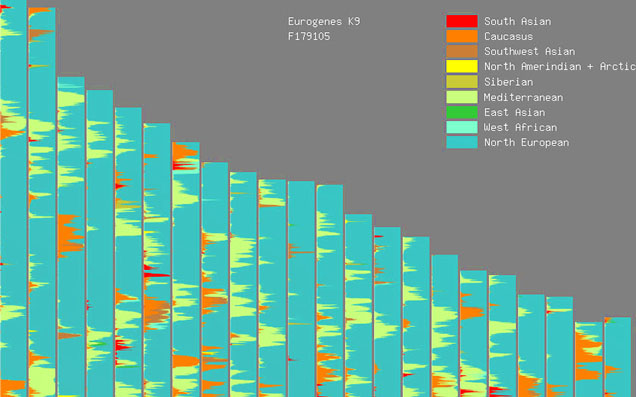
If that’s not enough, you can even get your very own personal chromosome painting:
For anybody interested in learning more about DNA, or even just playing around with results, this is one cool set of utilities. Kudos to Gedmatch, a DNA geek’s dream site!
SOURCES
- ISOGG Wiki (http://www.isogg.org/wiki), “Y chromosome DNA test,” rev. 23 Jul 2011. ↩
- ISOGG Wiki (http://www.isogg.org/wiki), “Mitochondrial DNA,” rev. 30 Jul 2010. ↩
- ISOGG Wiki (http://www.isogg.org/wiki), “Autosomal DNA,” rev. 8 Feb 2012. ↩
- ISOGG Wiki (http://www.isogg.org/wiki), “Centimorgan,” rev. 24 Jul 2010. ↩


My results are in, my results are in! (Ancestry DNA, this morning, sent in a week after you!)
Highest matches in 4th – 6th cousin range (wasn’t expecting more, but one can hope!) … and AT LAST a few German names among the mix!
Besides matches, another hope for doing test was more meaningful breakdown than FamilyTreeDNA currently has.
For my paternal German / Lutheran + maternal Austrian / Jewish heritage,
Family Finder: 85% Tuscan, 15% Basque, Finnish, French, Orcadian, Russian, Spanish
Ancestry DNA: 43% Central European, 38% European Jewish, 17% British Isles, 2% unknown
As you reported last week, much better! Don’t get me wrong, the rest of Family Finder was been terrific! – reporting matches to Brook Schreier Ganz, and Bennett Greenspan’s wife.
Congrats on getting your results — wouldn’t have minded if you’d matched ME, but no such luck, darn it!
That’ve been way-cool! … but would’ve been interesting why didn’t also match up at FamilyTreeDNA 🙂
Dashed out of door yesterday, late to an all-day outing (having totally lost track of time with arrival of results), so just getting around to thanking you for THIS post… I’ve tried a couple of matching sites, thought this was one of them, but never found this level of info! So thanks for spur to review what I did and figure out how I missed!
Dang, forgot to first hit reply so linked to your message; sorry
It’s sure a great site with tools nobody else has! Glad you’re finding it helpful.
Judy,
Thank you so much for highlighting GedMatch. This sounds right up my alley. One of my greatest frustrations with FamilyTreeDNA has been all those potential matches with nothing to show for it. We’ve made no confirmed connection on either of the two kits I manage. This is not a fault of FamilyTreeDNA but I think the more sites you can share your raw data on the better chances of finally making a genetic cousin connection ‘real’ through a genealogical connection. Can’t wait to try it out.
I understand the frustration, Rory — it’s a tough road to hoe to trace those matches and often it just can’t be done. So any and all tools we can find — good additions to the mix.
Love Gedmatch! Did you click on the oracle?
I did… but I’ll be honest and say I’m not sure exactly what it was trying to tell me… Wanna teach me?
Single Population are population groups your DNA matches with most likely toward the top. Mixed population groups takes the two groups from the admixture with the largest percentages, for example Western European and Mediterranean from your Dodecad chart above. The primary population (Western European) includes population groups your DNA matches with most likely toward the top. The secondary group (Mediterranean) lists population groups your DNA matches with most likely toward the top.
That’s how it was explained to me anyway and with reading the differences between the admixtures seem to be accurate.
Very helpful, thanks!!
I need to know if I have native American heritage but I can’t afford to pay the costs. Can you help me please?
Without either a documented paper trail or a DNA test, Melvin, nobody can tell you if you have native American heritage. You’re going to have to pay the piper one way or the other to know for sure.
How will we be able our AncestryDNA autosomal test information?
Soon, GedMatch will allow you to upload your data there to compare to others who’ve uploaded their data from any of the testing companies. And after May 1, you can do the same at Family Tree DNA for a fee — and that’s where you’ll get your best results for your data since there are great tools available there.
Can’t get on the site – just get a blank screen with Error at the top. Please explain what I’m doing wrong.
I’m not sure, Erin. The site comes right up for me, using Google Chrome and Firefox.
not sure if my dna completed it’s upload. how do I check?
Got this message:
Kits marked with * have not been tokenized and have not completed batch processing.
I’m confused
After you upload, it takes some time to have all the data processing done. If your kit hasn’t completed batch processing, that’s all — it needs more time.
My upload is going on 12 hours without tokenizing. So, how long is time to process? One becomes anxious as to whether the upload was error free. I am using a Mac and Safari browser.
Other than waiting, which is difficult for one with OCD, are there any other steps one can take.
That’s a bit long, John. If it’s not finished by tomorrow, I’d delete and start again.
are the results from dodecad and the other tools really accururate because i’ve had some surprising results.
Ray, none of the results are “really accurate” because they’re all constantly in the process of being revised to reflect new and additional data. We’re a long way away from being able to consider any of these admixture percentage tools “really accurate.”
Great review article, Judy.
I found out through Gedmatch that my mother and I are related to you.
22 cM total
16 cM longest
It’s a great site, Raymond — and as for being related to me, you have my sympathies!! (Seriously I have a lot of kits on Gedmatch using variations of mail addresses on my personal domain, so depending on which kit it is, it may not be me, but rather a cousin.)
Can’t find my uploaded info for kit f233490. Is it there or just maybe not completed yet. Should I delete and start over ?
Not completed yet (“Post-upload processing not complete for F233490”).
Could you please explain what it means when it says 3.7 generations to MRCA. I understand most recent common ancestor, but I don’t understand 3.7.
It’s an estimate of how far back, in generations, you have to go to find your most recent common ancestor. You to your parent is one, to your grandparents two, to your great grandparents three, and this is estimating that you’re much closer to having your 2nd great grandparents as common ancestors with your match than your great grandparents. But please keep in mind: this is an estimate only and it’s often wildly inaccurate because of the random way autosomal DNA is inherited.
what is the gedmatch site administers email address? It says to contact you if you have problems but doesn’t geive the amil address
The entire site is down at the moment. When it’s up, the contact info is there.
Did you get an answer to this? I would like to see my results without comparing them. I have a chart for my dad from FamilyDNA, showing his numbers, but I can’t figure out how to do it on gedmatch.
What kind of DNA are you trying to look at, Nancy? If it’s your autosomal DNA, you can download and look at your raw data file, but it won’t tell you much: the proof of the DNA pudding is in the matches.
Hello! I noticed that this article is from a long time ago. However I was wondering if you could tell me. What project do you think is the most accurate on Gedmatch admixute?
Christian, there’s no really good answer to that question. Each test has its benefits and drawbacks as the reference populations are different. I’d suggest running your results through several to see where they differ and where they are the same.
Is there any place I can see a regional breakdown? I am not sure what North-East Europe, or West Asian, etc. mean? I have been looking for maps without much success. Thank you.
You’re going to need to do some research to figure out what the reference populations are, I’m afraid. Googling each test type with the phrase reference population may help.
Are there any security issues to be concerned with when uploading raw DNA to Gedmatch? Ancestry has a cautionary statement when you try to download the raw data so I wonder if I should be concerned about sharing this? Thanks.
In theory, some portion of your identity that you didn’t choose to disclose and of your health risks could be determined by a very sophisticated fellow user of GedMatch who did a careful analysis of your results versus his or her own results. In reality, darned few people know enough or are motivated enough to bother. So is there any risk? Sure. Is there a risk high enough to warrant not using this tool? Not to me. Your mileage may vary.
Judy:
How many matches on a segment would you say definitely proves that you share that particular common ancestor? Also, I am matching “cousins” back prior to 1600 no problem. Only problem, I see, is that I am trying to come up with some sort of spreadsheet to follow all my leads. Since I have submitted five kits and waiting on number six from Ancestry, it is a lot of information. Wish they’d hurry up on the batching!
It isn’t the number of matches on a segment as much as it is that you have one or more segments of a size to suggest that the segment is shared by reason of inheritance (“identity by descent” or IBD) and not random chance (“identity by state” or IBS).
Hello, I have recently received my results from 23andme. I wanted to upload my results to GEDmatch but I think the site is still down. Do you know when the site will be back up?
I’m afraid I have no idea. Keeping tabs at the site itself is the best way to monitor the situation.
It’s up now, I just got results from 23andme and uploaded them last night
I am new to dna genealogy so I hope my question doesn’t seem silly. Anyways…I am trying to pinpoint a dead end on one family group. I have had my mother, one of her first cousins, and a second cousin tested, (waiting on results of another second). Which the common ancestors would be my mother’s paternal grandparents. If I make a chromosome spreadsheet would I use each of their entire end and start numbers or only the ones they share in common. It seems to me, that it would be only the ones in which they share, so therefore looking for others who fall between these chromosome values should be my mission. Correct???
Thanks for your time,
Sherry
You’re looking for people who are AROUND the same values, Sherry, since remember: each and every time the autosomes are passed on, they get randomly mixed and jumbled. So some cousins may overlap a segment completely and others may overlap only part of a segment (or none of it). And remember that you get TWO copies of each chromosome so even if someone LOOKS like he matches your mother and her first cousin, he may match each of them on a different copy of the chromosome.
Judy, your blog post today, 13 May 2014, on ethical standards for genetic genealogy has finally prompted me to ask for clarification about something in your GEDmatch post of 12 August 2012. Not having used GEDmatch, I’m uncertain what the statement, above, that “you can compare your results with the results of all other Gedmatch users who’ve made their results public,” actually means. Does it mean that GEDmatch will display the names, kit numbers and e-mail addresses of all matches for User X, who has agreed to make his/her information public, or only the names, kit numbers and e-mail addresses from User X’s match list of people who have themselves given GEDmatch permission to make their results public? If the answer is the former, I don’t feel I have the right to upload my match lists without the permission of each and every match (and lots of luck getting several hundred people to reply to a request).
Many thanks for your much anticipated input.
Linda
Linda, I personally agree that we should NOT upload our match lists to Gedmatch. Uploading our own raw data, fine. But the match lists… no.
Does GEDmatch offer the option to upload only one’s own raw data without the match lists?
As of right now, I don’t even see a place to upload the match list any more. It’s just your own raw autosomal and X-DNA files they want.
Can someone please help me with this?? I am half English and half Italian. My ethnic Admixtures look correct for this, and in One and Two Populations Sharing I get pretty good Results overall, i.e., things like English, Kent, West-Central German, Tuscan, North Italian, and South Italian-Sicilian, yet in Three and Four Populations Sharing, “Greek” keeps coming up almost constantly. In Harappa World, it is designated as “Southern Greek” and “Central Greek”. Albeit, people move around, but none of my ancestry was from anywhere near areas of Ancient Greek colonial contact, my Italian lineages are from Tuscany and Abruzzi, so that scenario is highly unlikely. Could these readings just be speculations based on Mediterranean geographic and or genetic proximity, or does this necessarily really indicate actual Admixture from Greece proper? Any help with this is greatly appreciated. GEDmatch Kit # M213249
Ashton, I’d suggest you read through the posts on these admixture percentages — Admixture: not soup yet; Playing with percentages; and Those pesky percentages, among others — to better understand the limits of this information. The science just isn’t there yet. It may never get there.
What does the message “mysql_connect ERROR (10sel)” mean? Why are there so many ongoing problems when attempting to use GEDmatch?
GedMatch is a free, volunteer-run website that depends on donations to be able to operate at all. Trying to set it up and keep it running in the face of all the user demands is a daunting task. Sometimes there are database problems (that’s what the mysql error message means) and we just have to be patient. (Right as I type this, for example, the whole site is down.) The one thing every user CAN do, to help, is donate. When the site comes back up, that’s what we all should do!
I agree we should HELP and make a donation. But we need to be informed How and Where to send it???
The site page has now changed so you can click right through to donate, Ross.
Judy, thank you very much, and now it makes more sense. Being 50% Italian and 50% English, on 23andMe my total SNP matches are to Italy, Britain/Ireland, and France/Germany, and that’s it. To me, it’s pretty obvious that the Germany to Britain convergence, seen on both 23andMe and GEDmatch, is due to Germanic Admixture from the Anglo-Saxon epoch, and on GEDmatch itself, this hypothetical “Greek” showing, is probably nothing more than a genetic affinity, perhaps dating from a period such as the Neolithic. For these speculative reasons in regards to Autosomal DNA, it is almost easier for me to use the Haplogroups per se as a more effective and identifiable method of reckoning ethnic ancestry, even though they represent much smaller portions of our make-up overall. Yet, they are in many ways, more concrete. Example, from my English side, my Y Haplogroup is I2a1-L233, and the consensus on this Subclade is that it originated on the NW coast of what is now Germany, and arrived in Britain in the Dark Ages. My MtDNA Haplogroup, from my Italian side, is J2a1, a minor J Subclade, historically connected to the ancient Alps.
Glad it’s starting to make more sense for you now!
I show 5.3 percent Southern. What does this mean? thx
5.3% southern what?
Thanks for the info on GEDmatch. I only learned of it a couple weeks ago. They’re in the middle of changing servers, so I have to wait before uploading.
Why do people buy the test, get their results, and never to anything with it? They don’t upload their tree. They restrict their matches to ONLY the projects they’re in. (My brother has matches in a project at FT-DNA that don’t show up as a match for him anywhere else on the site.) It’s so restrictive and unhelpful. What a waste.
BUT… I’m glad to hear of GEDmatch and will upload as soon as I can.
Thanks again for the info!
The “why would you test if you’re not going to get going with it” question is one that frustrates us all, Kathy — but there are some good reasons why people might test and never want to post a tree or respond to inquiries. They may have tested solely to get an answer to one specific question, and really not want to be in touch with anyone else. I try, hard, to understand that — and fail routinely. I have two current matches at 23andMe who haven’t responded to contact requests. One is at a projected second cousin level. The other is at a projected first cousin level. And my curiosity about both of these is about to kill me.
I was noticing on the chart you displayed it has a “T” in the Triangulate column. In the gedmatch results which are displayed for my matches- I don’t seem to see that Triangulate column. Is that something they no longer do? Or is there a mode I have to be in for that to appear?
No, that feature has been disabled for the time being because of the computing demands. Keep an eye out for it to return down the road (we hope!).
I upload my dna from Ancestry.com, but somehow I have three kit numbers, is this normal or did I do something wrong and should I delete two?
Unless you have three kits, you shouldn’t have three kit numbers.
I have left question on ged Match genforum but no answer. I can not find an email address for Gedmatch to ask them. I really think that there is a possible error in their uploaded information since they are having some problems. Our kit #F339358 has been posted for several months. A known distant cousin has submitted his information kit A722251. If you put these in one to one match you get over 30 cnM on a chromosome but if you search on one to many it does not show up on either kit! So you can not look at any of the other types of comparisons. Thanks for a potential answer.
Right down at the bottom of each page is a copyright statement. The word Gedmatch in that statement is a link to the email address. Click on it and it should open your email program with the address already filled in.
Thanks I did send it to the one address that I found.
When I attempt step one to download, http://1v2.gedmatch.com/login1.php my antivirus rejects site. Other than shutting the antivirus is there another way to get started? I have raw data ready to go somewhere but cannot seem to set up an account………thanks
I’m assuming your antivirus program is Avast? It’s been reporting Gedmatch as a problem for a few days, and no other virus program has any issues (including the rather expensive one I use). So I’m assuming the issue is with Avast, not with Gedmatch.
I ignored Avast’s warning and tried to sign up anyway. I gave out my email address and got an error when I tried to send my data over. The very next day I began to receive a daily barrage of penis enlargement type emails. Twenty or more a day, and gedmatch is the only site I had visited.
Sorry you’re having the issue. Hope you’ve reported it to GEDMatch.
You say that Ancestry dot com does not have the raw data to download? I have down loaded my autosomal raw data twice. The first time was earlier this year (which I then uploaded to FamilyTreeDNA) and again today to be sure it still worked. There is a link to do so in your AncestryDNA settings.
This post was posted on 12 August 2012. AncestryDNA did not make the raw data available until March 2013..
Having problems uploading ftdna files to gedmatch. The autosomal loads, but the second file X chromosome seems to freeze. I have deleted files and tried the x file first. It loaded completely, but the autosomal file would not load. Cannot find info to contact site administrator. Also have tried at different times. Like 5 am. Any suggestions?
Try GEDmatch (at) gmail.com
Hello my closest match at 23andme is predicted 2nd to 4th, likely 3rd cousin- we share 1.27% across 5 segments.
Yesterday she uploaded at gedmatch, and it show 3.5 to mrca.
What is our likely relation based off this info?
There’s no way to say for sure, because all of these percentages are a range. You would appear to be somewhere between the very low end for 2nd cousins and the very high end for third cousins.
Everything I have read about GEDmatch looks very good, but I am unnerved that the registration asks for my real name for ‘verification’ purposes. Do you know for what purpose they would need to ‘verify’ me and why anonymous is not okay?
I can’t speak for GedMatch, but my own sense of this is that, as a site that can be accessed in a public way, making sure the data is uploaded by someone who has a right to do it (by at least being able to identify whose data it is or should be) is a good thing.
I had a question about the calculation of generations. I recently transferred my data to Gedmatch.com and I have 3 confirmed 2nd and 3rd cousins. I also have a group of distant relatives that all four of us are match for. One cousin (3rd cousin, once removed) had a hit for the x-chromosome with the matriarch of the group. He wa the only male in his line up to my 3X great-grandmother. Do we assume that it is soley through our 3X great-grandmother and her mother and grandmother, as it is in mitochondrial DNA? Is it necesssay for his mother to do th emitochindrial DNA test? The generation span said 4.5. What does that mean?
You need to read up on the X-chromosome match and what it means, because it does NOT pass the way mitochondrial DNA comes down the generations. You can start here: X marks the spot. As far as 4.5 generations, it’s a rough estimate of the number of generations back to a common ancestor, so — assuming there aren’t a bunch of cousin marriages monkeying up the works — you could be anywhere from likely third to likely fifth cousins.
What does the .4 mean when it says MCRA 2.4? Why not just 2 MCRA? Thanks!
It’s an indication of a possible partial generation, such as a second cousin once removed, as opposed to just a second cousin.
Have have uploaded a FTDNA Build 37 autosomal raw data file to gedmatch, but a message has come up “You still need to upload the file containing X-DNA data”. What does this mean please? Does gedmatch not work with autosomal dna only?
Oh I think I have it! It’s the second Build 27 data file? What is the difference between Build 27 and Build 26? I have used Build 27 – does it make any difference? Thanks.
Is the following diagnostic from gedmatch a problem (ie I need to give the upload another try), or do I just need to wait (just uploaded it last night)???
And I cannot imagine not donating to gedmatch. What am amazing service.
Diagnostic message from gedmatch:
Kit (kit number) was uploaded on 2015-05-31 01:59:10 (GMT / UTC)
The intermediate SQL file for kit M155784 was also found. It is normally deleted during the tokenizing process. Counts are shown below, to help diagnose any related problems that might exist.
Below is a SNP count for each chromosome, as stored in the intermediate SQL file. After tokenization, token file counts will be somewhat less than the SQL file due to removal of no-calls, inserts and deletions. Missing chromosomes, usually seen in the high numbered chromosomes, are an indication that the file did not completely load. At a minimum, you should see counts for all chromosomes 1 through 22. 23andMe customers should also see counts for ‘X’. Counts for ‘MT’ and ‘Y’ are not shown in this table.
SQL Table Data:
Chr DB SNP Count
1 46527
2 46033
File does NOT contain any X-DNA data.
‘–‘ no-calls = 488
Kit (kit number) has not been tokenized. It is not available for one-to-one comparisons.
Kit (kit number) has not completed batch processing for the one-to-many comparison results.
Please wait while matching segments are counted. This could take a few minutes if the server is very busy. If it takes longer than 5 minutes during peak periods, the server may have timed out…
You have no matches with ‘A’ kits.
You have no matches with ‘F’ kits.
You have no matches with ‘M’ kits.
No matches were found for kit (kit number) in the one-to-many results database.
Potential problems found with this kit are shown in red above. It may mean that there was a problem with the upload, or it simply hasn’t completed some phase of processing yet. Kits usually don’t take more than a few days to process.
If you need to delete this kit, you may do it yourself. Click on the ‘Edit’ link at the bottom of the ‘Manage your Resources’ box on the left side of your GEDmatch home page. If you need help, you may contact the site administrator at GEDmatch@Gmail.Com
It doesn’t look like the upload was successfully completed. In your shoes, I’d delete it and start over.
Just found this article but notice it goes back to 2012 which I suspect was before triangulation became a Tier 1 utility in Gedmatch as I don’t see how I can produce a table like the first one shown above. I presume it is showing the specific allele match ups in the column labeled Triangulate. Although I am a Tier 1 member I don’t see a way to produce this same information now. Am I missing something or has this feature just gone away?
No, that triangulate column wasn’t showing the alleles themselves but only clickable links to launch the triangulation tool. That tool is now a Tier 1 tool.
Please explain what this is referring to: Kits marked with * have not been tokenized and have not completed batch processing.
I uploaded my data early in September to Gedmatch and I’m still getting the above message. I thought batch processing was relatively quick. This is the 26th of September.
That’s the message while waiting for processing. After this much time, it means the upload failed. You should delete and try again.
Thanks so much – I did as you suggested and uploaded again – all went well this time. Very fast.
Excellent — glad it worked better the second time around.
My boyfriend and I have both put our DNA on gedmatch and so has my 2nd cousin Sherry and my 2nd cousin Dennis. Interestingly enough my second cousins have no DNA in common with me. Sherry’s shared two lineages came together more recently than mine. We are both descended from the same Stead and Leduc ancestors in the 1800s but hers came together in the last century and mine in the one before that.
Dennis’s and me are both descended from Eleazer Blackman Durkee but him from his first wife and me from the second, so we really are half 2nd cousins.
So autosomal DNA has been a huge help for me but it has its problems. I have 16 HINTS on ancestry. 15 of them are maternal and the other one is set to private but I can tell from surname searches it is on my paternal side (leducs). I have been pressuring my paternal cousins to take the DNA tests. One of them agreed to do it and we are awaiting the results any time now from Ancestry. Another one is one generation removed on that side. He is a former Professor of History (Native American studies) and he has agreed it do it.
Re downloading a Gedcom into Gedmatch.
Have already downloaded 2 previous gedcoms,perfectly fine.
My latest one ,goes through the same proceedure,even received a gedcom number,when I go to my page to look at the results,it comes up blank.Have deleted the this gedcom and proceeded to try again,same thing happens.Any suggestions on this matter?Thanks
You need to wait until the kits are completed (which can be hours even days after an upload) before you can do a one-to-many analysis. If you have waited that long, then there are support groups for GEDMatch on Facebook if you can’t get help at the site itself.
I have downloaded Ancestry DNA to a file ready to share with gedmatch but when I try to log in, it is not accepting my
user name. There was no way to retrieve it and I tried to reregister and it said I was already registered. I can find no
telephone number or e-mail address to make contact. Any help with this will be appreciated. Thank you.
The only email address on the site is gedmatch@gmail.com
Thank you
I tried to download my DNA from Ancestry to Gedmatch.com and was totally unsuccessful. It said their was a problem and to contact gedmatch administrator however I cannot find where or how to do that and there are no phone numbers or contact information at that I could find. very frustrared
Down at the bottom of every page is a tagline: Web site and contents ©Copyright 2011-2016 by GEDmatch, Inc. The words GEDMatch, Inc., are hotlinked to the site’s email address.
This is an awesome blog, thank you! Do you have a thread where you discuss chromosome 23?
BTW, I have been able to coonect to 4 unknown cousins on 23andMe, confirming those 4 ancestral lines and 3 additional lines on Gedmatch, but I have 20 years of research to base it on. I love the times we live in!!
Chromosome 23 is the X chromosome, and I have written about that on occasion: see X marks the spot and Whence the x, for example.
I’ve been tryng and trying (and trying and trying) to upload my DNA info to gedmatch and can’t do it. It says my email is in use so I can’t register, and the password I give is invalid. I’ve done the thing where they send you a code so you can reset your password, but it requires NOT closing their window while you get your code! I can’t do that on my system! There’s no way I can deal with them!
At the bottom of each page at Gedmatch is a hotlinked version of the website name. Click on that and it should load your email program with the address to send a request for assistance.
Hello there!
I took the FTDNA test and my results came out a few days ago. I got my raw data uploaded to GETMacth and now I’m a lil bit confused. I have no % of Asia or Oceania in my test result, but when I play around with some GEDMatch admixture tools, they show me little to a sorta high percentage Asia and some Oceania. Would you know why that’d happen? Also, using some admixture tools I see the same % of Amerindian as my FTDNA test, but none if I use others. I’m kind of puzzled.
Each tool is applying a different analysis to the underlying data and so each tool is looking for and comparing you to a different data set. You’ll see differences among the reports as a result. Keep in mind that the science is very new in this area and your results can be expected to change over time. This is not an accurate reflection of your actual ancestry just yet below the continental level.
cANNOT LOGIN TO GEDMATCH ACCOUNT WITHOUT RE-REGISTERING. whether SOMEONE HACKED INTO ACCOUNT OR NOt, MY LOGIN &EMAIL NO LONGER TAKES. sOMEWAY, SOMEBODY CHANGED A PORTION OF EMAIL ADDRESS.
THEY PUT A COMMA BETWEEN LETTERS. …. I cannot change my user email I keep getting an error ” password or email address is invalid” I tried a different email address , but it reverted to (the old one). How can set a new email for my account.
I understand that since this email was used to open the account that Iwill lose all my data?
It also shows 3 listing *accounts. 2 are listed as Richard harris
& the other is listed as Richard James Harris.
There is a contact email address for Gedmatch at the bottom of every Gedmatch page (the site name is a hotlink that should load in your email problem so just click on it). Use that to contact the folks who run that site and explain your problem: they’re the ones who can fix it.
Hello, Judy. Hoping you can help me. I went on GedMatch this morning after not being on the site for several months. Two of my kits are now missing! They are the first two I uploaded, my mother and mine. Any idea what is going on?
Just saw your post about the email contact. I will try that also.
You should include your kit numbers in your email; I believe you may find that those kits had not been logged in to for some time and they were considered inactive.
I don’t doubt the cleverness of some of the programmers linked on GED, but really, they need to take a few minutes to tidy up those tables and charts. Using abbreviations like HG instead of typing out “hunter gatherer”. A lot of table columns don’t have titles so you don’t know what you’re looking at. And underscores instead of spaces, who still does that? I know it’s free and I do appreciate looking at… whatever I’m looking at, but I’m also a database programmer and I just wouldn’t release stuff like this publicly. The explanations and plain language titles are just as important as the code.
Um… gift horses… just sayin’ …
How is it possible for anyone to get your health information via Gedmatch.com. Don’t people have to have your actual raw dna to get that information. I am confused. Then it says if you don’t want for others to know about your health problems, then to go private. How do I know if I have any health problems that require I go public or private? Where is this information in the kit located?
If I have an inherited medical condition linked to a reported segment, then I could in theory find that anyone who perfectly matched me on that segment might also have that inherited condition. It’s more of a theoretical risk than a real risk but it’S still a risk.
I’m new to all this business. I’ve got everything downloaded and uploaded, and have my kit#, but I don’t know where to go,to login and get started. Help!
A good place to start would be this free video by genetic genealogist Angie Bush: https://www.youtube.com/watch?v=acGJmLlsWg4
How many batches does gedmatch have to process, before the tokenization is finished?
Not all that many, so if you don’t get tokenization within 24 hours, delete your upload and start again.
Can you comment on how the police might have used GEDmatch to find the Golden State Killer?
Working on this for Sunday’s DNA blog.